Who was Ada Lovelace? The woman who saw computers coming
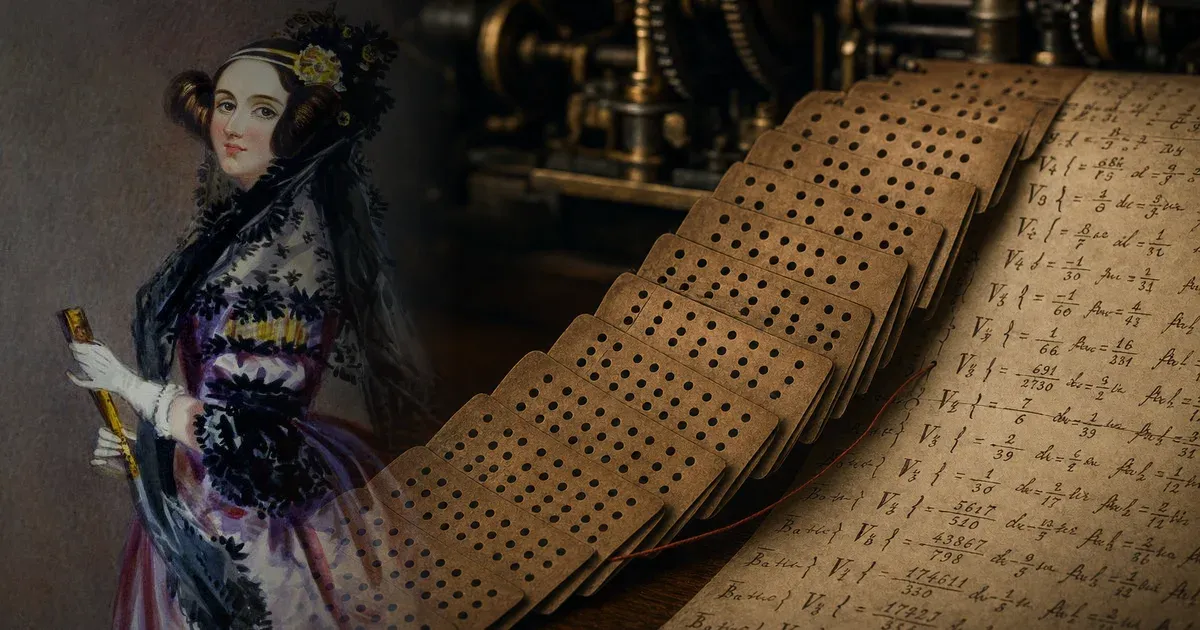
Ada Lovelace (1815–1852) was an English mathematician who, in 1843, published a step-by-step method for a machine to calculate a sequence of numbers: the first computer program ever printed. The machine it was written for was never built. The program contains a bug. And the most important thing she wrote wasn't the program at all. It was the idea, a century early, that a computing machine could work on music, letters and logic as easily as on numbers.
She was 27.
In our game, players have typed her name 492 times. That puts her 125th among the 20,918 different women players have named, far behind Marie Curie at 2,210. Among the women who built computing, though, she stands almost alone, and the second half of this piece shows how alone. First, who she actually was, what Note G really says, and whether "first programmer" is a fair title.
Ada Lovelace at a glance
| Fact | Details |
|---|---|
| Born | 10 December 1815, London |
| Died | 27 November 1852, London, aged 36 |
| Full name | Augusta Ada King, Countess of Lovelace (born Augusta Ada Byron) |
| Parents | The poet Lord Byron and the mathematician Anne Isabella (Annabella) Milbanke |
| Known for | The Notes on Charles Babbage's Analytical Engine (1843), including Note G, the first published computer program |
| Remembered by | The programming language Ada (1980) and Ada Lovelace Day, the second Tuesday of every October |
A childhood built as an antidote to poetry
Ada was five weeks old when her mother left Lord Byron, taking the baby with her. The separation was made legal that spring; Byron left England for good and never saw his daughter again. He died in Greece in 1824, when she was eight.
Her mother had a plan for the child: mathematics, early and hard, as a defence against what she saw as the Byron temperament. Byron had once called Annabella his "Princess of Parallelograms." Now she raised their daughter on geometry, tutors and strict daily schedules.
It didn't make Ada less imaginative. At twelve she decided to fly. She studied the anatomy of birds, experimented with wings, and planned an illustrated book called Flyology. Her last idea was to add steam power.
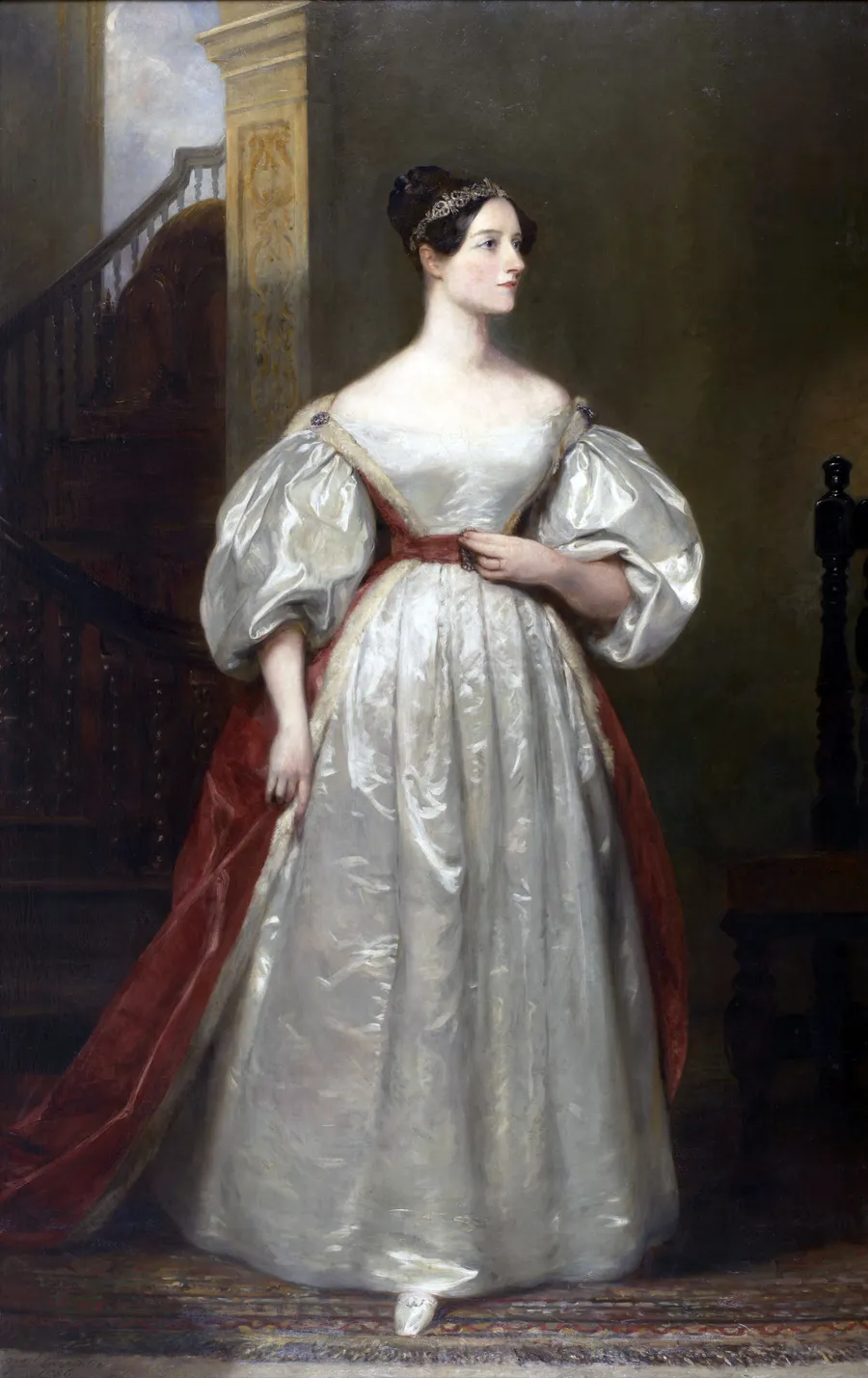 Margaret Sarah Carpenter's 1836 portrait. Ada complained that the painter was determined to display "the whole expanse of my capacious jaw bone, upon which I think the word Mathematics should be written." Government Art Collection.
How did Ada Lovelace meet Charles Babbage?
She met him at a party at his London house on 5 June 1833. She was 17; he was 41 and famous. Soon after, she and her mother went back to see the working fragment of his Difference Engine, a hand-cranked brass calculator. A family friend, Sophia De Morgan, remembered that other guests simply gaped at the machine, while "Miss Byron, young as she was, understood its working, and saw the great beauty of the invention."
Two people shaped what came next:
- Mary Somerville, the most celebrated woman scientist in Britain, became her friend and informal tutor. Mary Somerville has been named in our game exactly twice.
- Augustus De Morgan, a leading logician, taught her by post in 1840–41. Sixty-six of their letters survive. A 2017 study of them by the Oxford historians Christopher Hollings, Ursula Martin and Adrian Rice found "a gifted, perceptive and knowledgeable mathematician."
In between, she married William King in 1835, had three children by 1839, and became Countess of Lovelace when her husband was made an earl in 1838.
What did Ada Lovelace actually write?
She wrote the Notes. In 1840 Babbage described his new machine, the Analytical Engine, to engineers in Turin. A young Italian army engineer, Luigi Menabrea, wrote it up in French in 1842. Menabrea would become Prime Minister of Italy 27 years later. Ada translated his paper into English, then added seven notes of her own, lettered A to G.
Her notes ran to about three times the length of the paper they were attached to. They appeared in Taylor's Scientific Memoirs in 1843, signed only with her initials: "A. A. L."
The machine they described was something new. The Difference Engine could do one job. The Analytical Engine, on paper, could do any calculation you could describe. It had a store for numbers and a "mill" for doing arithmetic, and it took its instructions from punched cards, borrowed from the Jacquard loom that wove patterned silk.
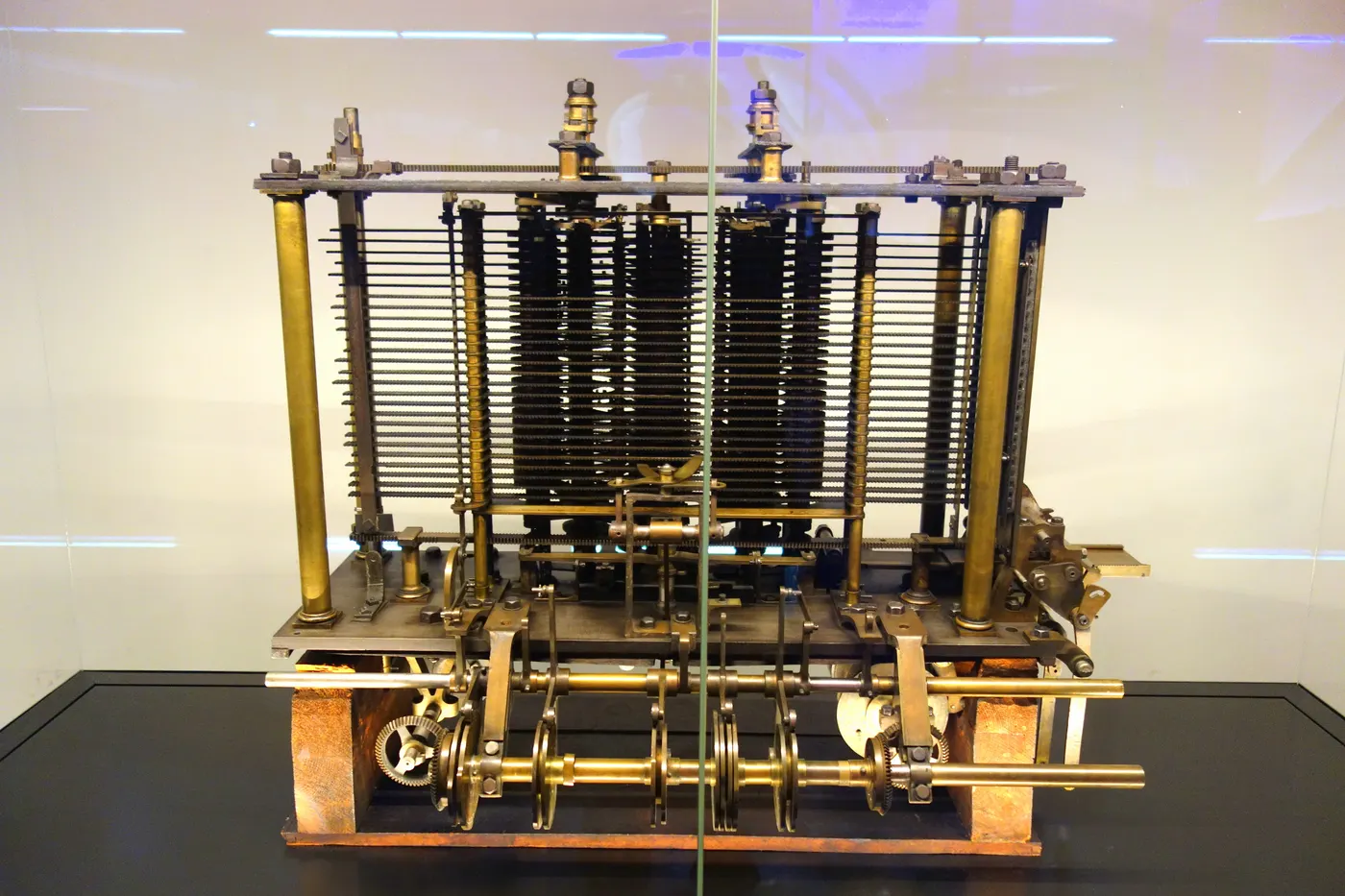 The only part of the Analytical Engine ever built: a trial model of the mill and printing mechanism, unfinished when Babbage died in 1871. Science Museum, London. Photo: Daderot, CC0.
What was the first computer program, and what was the bug?
The program is in Note G. It is a table of 25 operations that tells the Analytical Engine how to calculate a Bernoulli number, one of a sequence of fractions (1/6, −1/30, 1/42, …) that turn up in formulas for adding up powers of whole numbers. They get very tedious to compute by hand, which made them a good test of what the machine could do.
Read across the table and you can see ideas every programmer still uses:
- Variables. Numbered storage columns, V1 to V24, hold values that change as the calculation runs.
- Step-by-step operations. Each row names one arithmetic step, which variables it reads, and where the result goes.
- A loop. Near the bottom a line reads: "Here follows a repetition of Operations thirteen to twenty-three." Instead of writing out the same instructions again, the program reuses them.
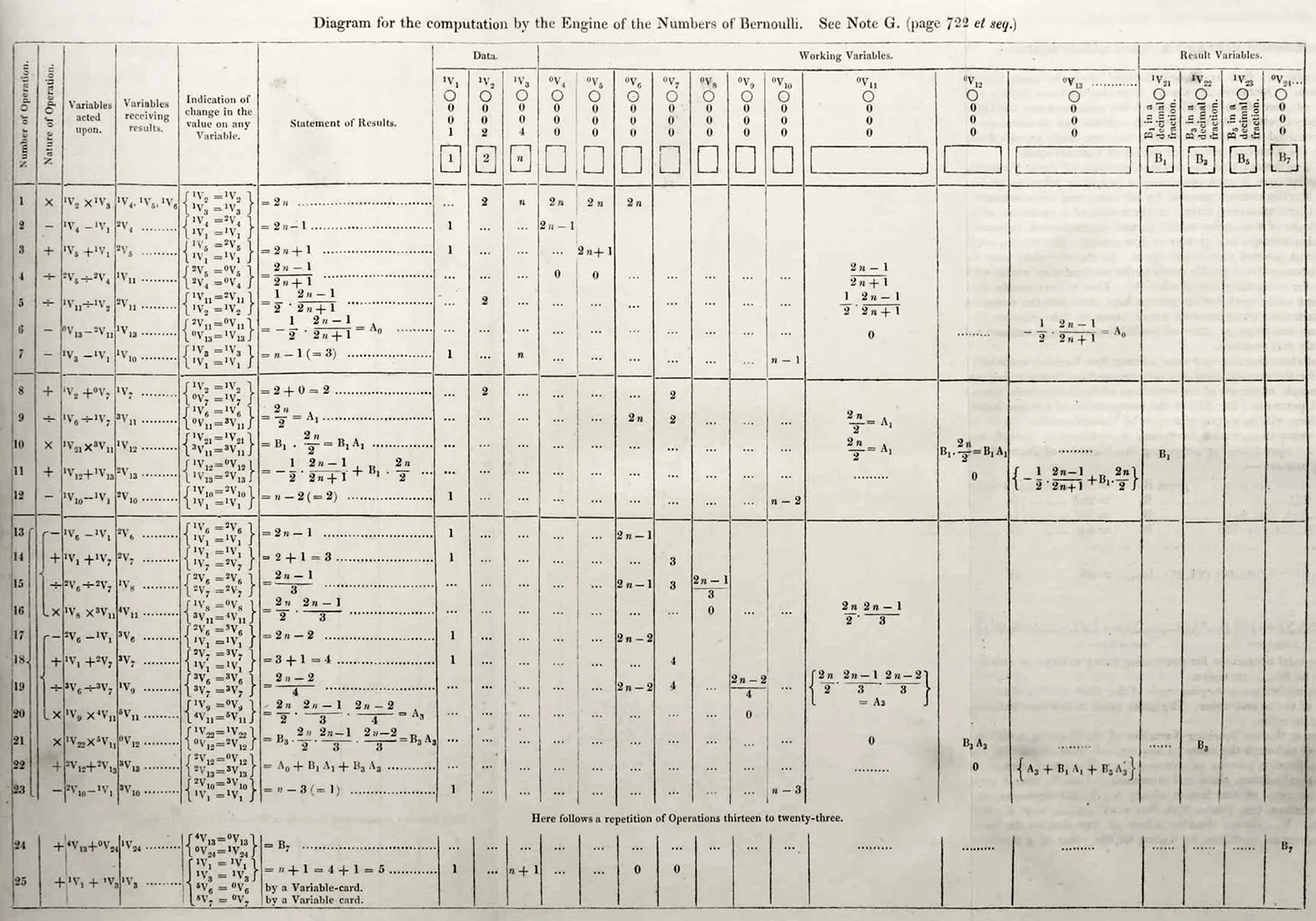 "Diagram for the computation by the Engine of the Numbers of Bernoulli," from Note G (1843). Public domain.
The bug is in operation 4. It divides V5 by V4 when it should divide V4 by V5, so the fraction comes out upside down. If you ran the table as printed, you would get −25621/630 instead of the correct −1/30. Nobody knows whether the slip was Ada's or the typesetter's.
The bug is a detail that makes her more believable as a programmer. Babbage's own memoir, written in 1864, adds another: he had offered to work out the algebra for her, and she "sent back to me for an amendment, having detected a grave mistake which I had made in the process." In the middle of the work she wrote to him that she was "in much dismay at having got into so amazing a quagmire & botheration with these Numbers." Anyone who has debugged code at 2 a.m. will recognise the tone.
Why her real breakthrough was about more than numbers
The idea that made Lovelace matter sits in Note A. Babbage built his engines to calculate. Lovelace saw that numbers were only one thing such a machine could work on:
"Again, it might act upon other things besides number, were objects found whose mutual fundamental relations could be expressed by those of the abstract science of operations… the engine might compose elaborate and scientific pieces of music of any degree of complexity or extent."
That is general-purpose computing: the idea that a machine that follows rules for manipulating symbols can work with anything those symbols stand for. She gave it an image that stuck:
"We may say most aptly, that the Analytical Engine weaves algebraical patterns just as the Jacquard-loom weaves flowers and leaves."
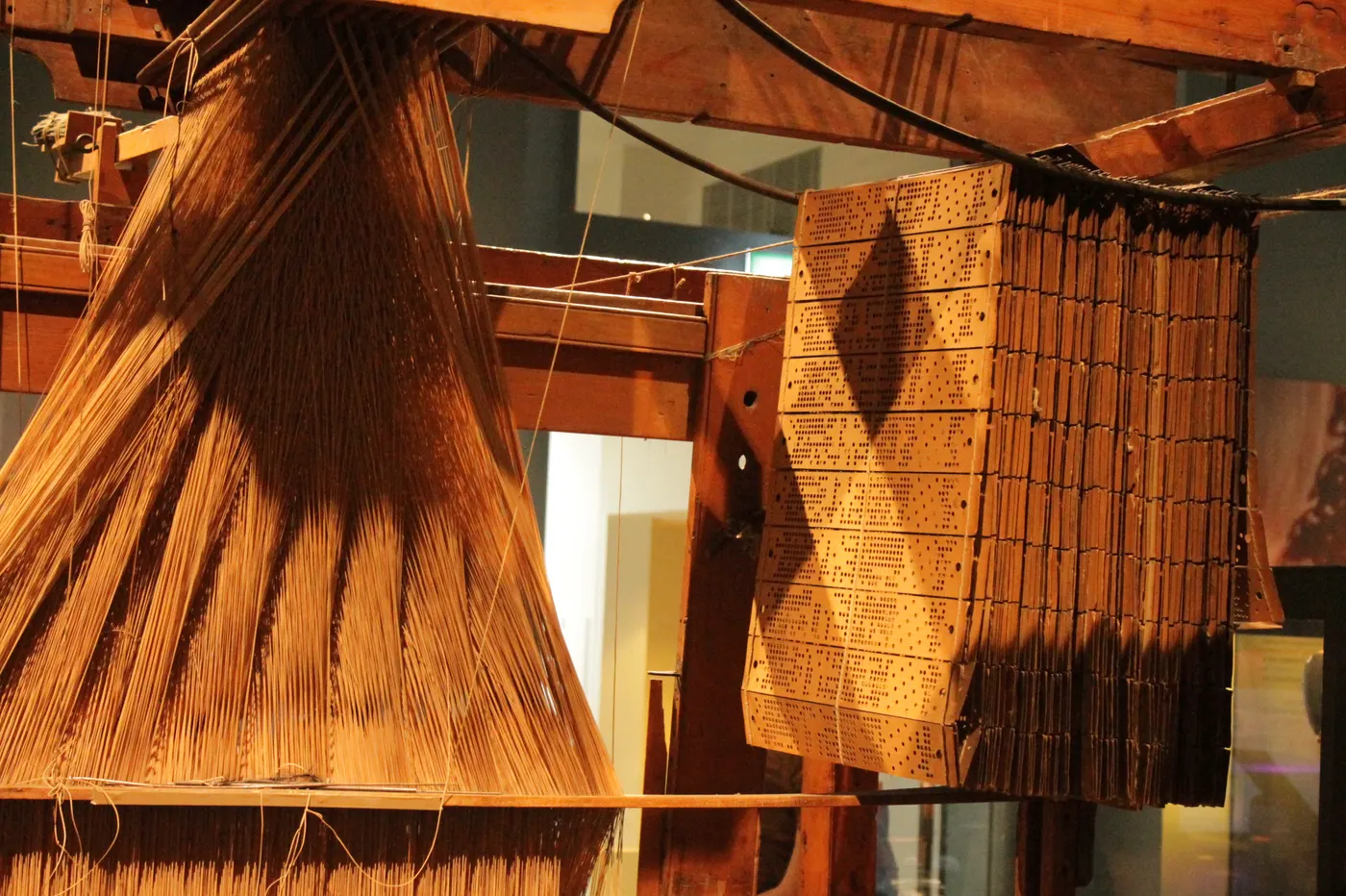 A Jacquard loom and its punched cards, the technology Babbage borrowed to feed instructions to his engine. National Museum of Scotland. Photo: Stephencdickson, CC BY-SA 4.0.
She also drew a line that people still argue over. In Note G she wrote: "The Analytical Engine has no pretensions whatever to originate anything. It can do whatever we know how to order it to perform."
In 1950 Alan Turing answered her by name. His paper "Computing Machinery and Intelligence", the one that introduced the Turing test, has a section called "Lady Lovelace's Objection." Every current argument about whether AI can be creative is, knowingly or not, a reply to a sentence she published in 1843.
Was Ada Lovelace really the first computer programmer?
Mostly yes, with a precise caveat. Babbage's own notebooks from 1836–1840 contain small programs for the Analytical Engine, so he was writing code for his machine before she was. Hers was the first program to be published, and the most complete and clearly explained of the period. Historians disagree about how much of the credit is hers, so here is what each side says:
| Claim | Verdict |
|---|---|
| She invented the computer | No. Babbage designed the Analytical Engine. |
| She wrote the first computer program | Partly. Babbage wrote earlier, unpublished fragments; hers was the first published, fully worked program. |
| She only polished Babbage's ideas | No. Her De Morgan letters show serious mathematics, and Stephen Wolfram, after reading Babbage's papers, found nothing "as sophisticated — or as clean" as her Bernoulli table. |
| She saw that computers could go beyond arithmetic | Yes. Even Doron Swade, who rejects the "first programmer" label, credits her alone with that leap. |
Ursula Martin, one of the Oxford historians who studied the letters, warns that "claiming firsts" oversimplifies history. We agree, and a fair version still makes Lovelace remarkable. Babbage built the machine. Lovelace was the first to put in print what such a machine might be for.
One more correction while we're at it: Babbage never called her the "Enchantress of Numbers." In a letter of 9 September 1843, he wrote "Enchantress of Number," singular, and in the same letter called her "my dear and much admired Interpreter."
Why did Ada Lovelace die so young?
Her last years were hard. In the late 1840s she lost thousands of pounds betting on horse races and ran up debts she eventually had to confess to her husband. A popular story says she was trying to build a mathematical betting system, but there is little evidence for it.
By 1852 she was dying of cancer of the womb, probably cervical cancer. She sat for a final portrait, at the piano, while in severe pain, and that August she asked Charles Dickens to visit her. She died on 27 November 1852, aged 36, the same age her father had been when he died. At her request she was buried beside him, the father she never knew, in the Church of St Mary Magdalene, Hucknall.
How was Ada Lovelace rediscovered?
For a century she was a footnote. The revival came when real computers arrived:
- 1953: B. V. Bowden reprinted her Notes in Faster Than Thought, a book about the new electronic computers, and a generation of engineers read her for the first time.
- 1980: the U.S. Department of Defense named its new programming language Ada. Its official reference manual was approved on 10 December 1980, her birthday, and numbered MIL-STD-1815 after the year she was born.
- 2009: Suw Charman-Anderson founded Ada Lovelace Day, held on the second Tuesday of October to celebrate women in science and technology. This year it falls on 13 October 2026.
Why players remember Lovelace and forget the rest
Here is what our game data adds. When players name a woman who built computing, they almost always name the same one:
| Pioneer | Times named | What she built |
|---|---|---|
| Ada Lovelace | 492 | The first published program (1843) |
| Katherine Johnson | 81 | Orbital calculations for Mercury and Apollo |
| Grace Hopper | 74 | The first compiler; the road to COBOL |
| Margaret Hamilton | 28 | Apollo guidance software |
| Mary Jackson | 11 | NASA's first Black woman engineer |
| Dorothy Vaughan | 10 | Led NASA's computing unit; early FORTRAN expert |
| Lynn Conway | 10 | Modern microchip design methods |
| Frances Allen | 2 | Compiler optimization; first woman to win the Turing Award |
| Joan Clarke | 2 | Codebreaker at Bletchley Park |
| Radia Perlman | 1 | The spanning-tree protocol behind Ethernet networks |
| Karen Spärck Jones | 1 | Inverse document frequency, a foundation of search engines |
| Annie Easley | 1 | Software for NASA's Centaur rocket |
Across these twelve, Lovelace takes 492 of 713 mentions: 69%. We call it the Lovelace effect, the computing version of the single-scientist trap, in which Marie Curie is the one scientist most players reach for. Cultural memory keeps one woman per field in circulation, and in computing that woman lived before computers existed.
Karen Spärck Jones sums up the problem. In 1972 she published the idea, inverse document frequency, that taught search engines which words in a query matter most. Some version of it probably helped bring you to this page. Players have named her once.
Name Ada, then name the next one
Ada Lovelace's whole contribution was seeing further than the machine in front of her. You can do the same in your next run: when you type her name, treat it as a starting line. Name Grace Hopper, then Margaret Hamilton, then Karen Spärck Jones. That's three extra names, and three women who have been waiting a long time to be counted.
Want to know where the others stall? See how many women most people can name, browse the full directory, or look at the live data.
Sources
- Ada Lovelace's Notes, full text: Sketch of the Analytical Engine with notes by the translator (1843)
- Stephen Wolfram, Untangling the Tale of Ada Lovelace (2015)
- Hollings, Martin & Rice, The Lovelace–De Morgan mathematical correspondence: a critical re-appraisal, Historia Mathematica (2017)
- University of Oxford, The mathematics of Ada Lovelace
- Alan Turing, Computing Machinery and Intelligence, Mind (1950)
- Computer History Museum, The Babbage Engine
- Karen Spärck Jones, A statistical interpretation of term specificity (1972)
- Game figures: player mentions in Name 100 Women, as of 29 September 2026.
Cover: Alfred Edward Chalon (attrib.), watercolour portrait of Ada Lovelace, c.1840 (public domain), composited with an illustration of punched cards and notation generated for this article. Body images via Wikimedia Commons, with licences noted in each caption.